


Restoring Without Erasing: 7 Design Principles We Used in Our 1898 Farmhouse


This post may contain affiliate links, which means I may earn a small commission if you choose to make a purchase through them, at no additional cost to you. I only share products we have used, love, or would genuinely recommend as you begin your own reorigination.
Somewhere between demo and design, the decisions start to feel different.
After 5 years working on our house, Maggie, I can tell you at first, it is about what you uncover. What you save. What you carefully set aside and hope you can bring back. But eventually, you hit a shift where you are no longer just preserving what was there.
You are deciding what comes next.
And that is where restoring an old house can quietly turn into something else entirely. Not just restoration. Not just renovation. But reinterpretation.
Because the truth is, most old houses were never meant to stay exactly the same. Rooms changed. Functions evolved. Families adapted them over time.
And that is something I want to explore more deeply in the coming weeks. Breaking down each room in this house, what it once was, and how those spaces have evolved into what we call them today.
But before we get there, I want to start here.
Because before we ever designed a single room, we had to decide how we were going to approach the house as a whole.

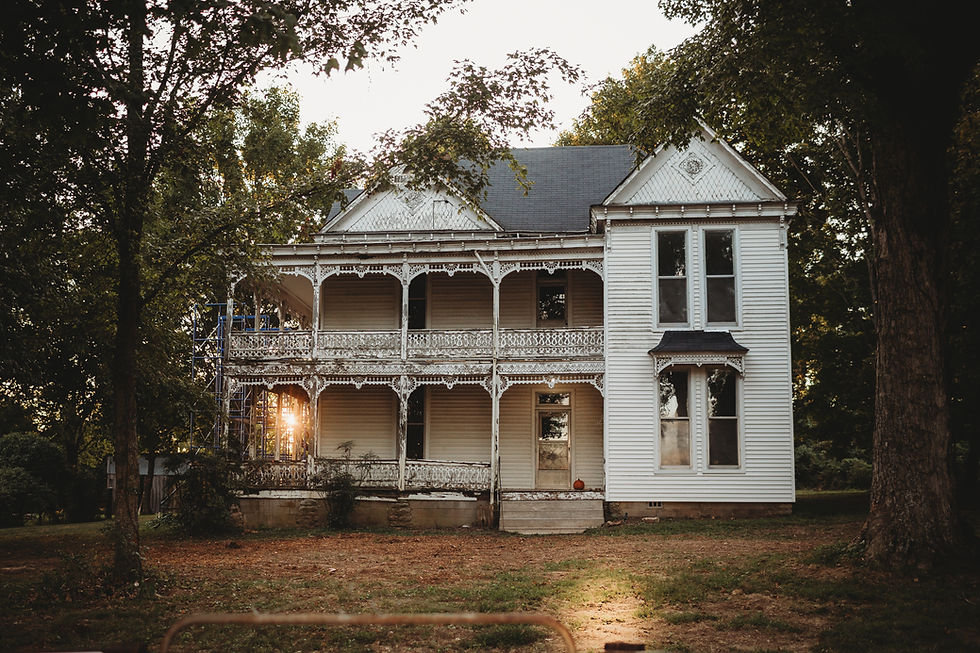
Not just what it would look like, but what we were willing to change, what we were not, and how we could move it forward without losing what made it feel like Maggie in the first place.
And also… hello, decision fatigue, anyone?
Because if you have ever renovated anything, especially an old house, you know the number of decisions you are expected to make is endless. And if you are making them one at a time, without any kind of framework, it gets overwhelming fast.
So if I can help take a little bit of that pressure off, it starts here.
Once you commit to a set of guiding principles, it becomes a lot easier to filter every other decision through them. It reduces second guessing. It reduces regret. And it saves you from doing the same work twice.
So when it came to designing our 1898 farmhouse, we were not trying to freeze her in one moment.
We were trying to move her forward without losing what made her feel like herself.
These are not rules. They are not preservation standards. Just the 7 design principles that guided decisions we made along the way and continue to guide how we shape this house today.
Let the House Lead
Before we made any design decision, we tried to understand what the house was already saying. (I broke down more about the design specifics of a Victorian farmhouse here.)
The placement of the windows. The symmetry of the rooms. The fireplaces anchoring each space. The way every room opened off the main hallway, connected but still offering its own sense of quiet.

Old houses have a rhythm to them. And when you work against it, you feel it immediately.
There were moments where we considered changing things. We had people tell us we might need to adjust the windows, make them smaller, or shift them to better fit modern layouts, especially in spaces like the bathroom where placement can feel inconvenient.
But those windows sat perfectly centered for a reason. They were part of a larger symmetry that defined the entire house.
This house was designed to be experienced from every angle, inside and out.
From the exterior, the windows, proportions, and placement all work together to create balance. And from the interior, that same structure shapes how the rooms feel and flow.
If we had changed even one of those windows, it would not have just impacted that one room. It would have disrupted the rhythm of the entire house.
And I knew that was something we could not give up.
The same went for the fireplaces. Keeping them, and being able to use them again functionally, was non-negotiable for me. They were a critical piece of how each room was designed and meant to feel.
And honestly, the original layout surprised us in the best way.
Coming from a more open concept home before Maggie, I was used to large, continuous spaces where everything blended together.

But stepping into this house felt completely different.
It felt like stepping into a slower, more intentional rhythm. Separate but connected spaces that still allowed you to move easily through the house, while giving each room its own sense of quiet and purpose.
So unlike all those home improvement shows where the first move is to knock out every wall, that balance of connection was not something we wanted to lose here.
Another place this showed up was in how we approached color.
Instead of starting with a palette we loved and trying to make it fit the house, we pulled from what was already there.

The fireplace tile was one of the biggest influences. Those colors were original to the home, and they gave us a starting point that already felt grounded.
From there, everything else began to build naturally.
It was not about choosing what was trendy or even what we liked most in isolation.
It was about choosing what made sense for the house.
Sometimes the best design decision is not changing something.
It is recognizing that it was already right.

So when you are faced with a decision, start there.
What was originally here?
Can it be preserved or reinterpreted?
Is there something in the house already, materials, colors, details, that can guide the direction?
Your house is its own muse, if you let it be.
And if you are not sure what that direction is, look to houses like yours. Study them. There is so much inspiration in the way these homes were originally designed and lived in. (I’ve linked a few of my favorite old house books here!)
Because once you let the house lead, the rest of the decisions become a lot easier to make.
Trust your Instincts and Advocate for the House
One thing I did not fully expect going into this process is how much I would have to advocate for the house.
You spend more time in it. You study it. You start to understand how it works, what feels right, and what does not.
And in a lot of cases, that makes you the expert on your own home.
The reality is, most contractors are used to working on newer builds. Their recommendations are not wrong, they are just based on a different kind of house.
And what works in a new home does not always translate here.
So there were moments where we had to push back.

Moments where the easier option was not the right one. Where the faster solution did not respect the structure. Where what made sense on paper did not feel right in the space.
And that meant being very specific.
Where outlets were placed. Where light switches lived. How electrical was run. How HVAC moved through the house, and where it could be hidden without interrupting original features.
Those decisions were not always the simplest. Or the cheapest. Or the fastest.
But they were what made the most sense for this house.
And that is something I think is important to remember.
If something feels off, it probably is.
You are not crazy for wanting to do it differently.
You are the one living in it. You are the one shaping it.
And sometimes the best decisions are the ones that take a little more time, a little more thought, and a little more intention.
Preserve Where it Matters, Simplify Where it Doesn't
For us, it was non-negotiable to keep anything we could salvage. Doors, windows, wood ceilings, floors, walls. If it could be brought back, it was going back into the house. (I shared more about those first steps here.)

Especially the things that simply cannot be recreated.
Old growth wood. Original wavy glass panes. The kind of patina that only exists because something has been lived in, touched, and worn over time.
Those are not things you can go out and buy again. And once they are gone, they are gone.
Even the exterior gingerbread, what was left of it, stayed. It was not in perfect condition, but it was still part of the story.

At the same time, we had to be realistic about where it made sense to simplify.
Because if you try to treat every inch of an old house the same, you either overwhelm the space, or never make progress at all.
Closets were a big one.
(And honestly, I do not know that anyone is coming over to inspect my closets for original wood walls, lol!)
If anything, I would much rather take those original materials and use them where they actually matter. To repair damaged areas. To fill in places where something was missing. To bring continuity back to the visible parts of the house.
So in spaces like closets, drywall made more sense.
And that is where I think it is important to remember, you still have some creative flexibility.
Not everything has to be original in every single space.
There are places where you make it count. And there are places where you make decisions based on how the house needs to function today.
The bathroom is the best example of that.
There was not a bathroom in this house in the 19th century. Moisture was not something they were designing around.
In this century, it is.
So we made practical decisions there that would hold up over time, even if that meant using different materials than what was originally in the house.

And in the back mudroom, what used to be an old porch, we were essentially creating walls where none existed before. That gave us the opportunity to simplify the structure while still planning to layer wood details back in later.
Because character does not come from everywhere.
It comes from the right places.
The details that carry the most visual weight. The elements your eye is naturally drawn to. The features that define how a room feels the moment you walk into it.
So when you are deciding what to preserve, start there.
What are the defining features of the space?
What would feel noticeably missing if it were gone?
And is it something that could truly be replaced, or is it something that only time could have created?
Because once you identify what is irreplaceable, it becomes a lot easier to let the rest go.
Design for How We Live Now (Without Erasing the Past)
One of the biggest mindset shifts came from understanding that these rooms were not always what we call them today.
Bedrooms were once referred to as chambers, spaces that were far more flexible in how they were used (I shared more on this and more over in this post).
Rooms changed purpose depending on the time of day, the season, or the needs of the family.
And once I understood that, I felt a lot less conflicted about making changes.
Because adapting an old house is not new. It is exactly what has always been done.
We kept the footprint exactly the same. Every wall, every window stayed. But the purpose of the rooms shifted to better fit how we live now.
The parlor stayed the parlor.
But the original dining room became our bedroom.
The old kitchen space turned into a closet, a half bath, and a full bathroom.
And the rooms that were once bedrooms became our new kitchen and dining room. That made more sense for how we wanted to live, especially with access to the porch and the way we gather and entertain.

It allowed us to create a more natural indoor and outdoor flow where it mattered most, and more privacy where it did not.
Nothing about the house was erased.
It was simply reinterpreted.
And that shift in thinking changed everything.
Instead of asking, “What is this room supposed to be?”
We started asking, “What does this house need this room to be now?”
So when you are making decisions about layout or function, give yourself that same flexibility.
What works best for how you live today?
What spaces need to be connected, and which ones benefit from separation?
And how can you adapt the function without changing the bones that give the house its character?
Because once you understand that these homes were always evolving, it becomes a lot easier to move them forward without feeling like you are doing it wrong.
You are not undoing the history of the house. You are continuing it.
Mix Old and New Intentionally
Not everything in this house is original. And it was never going to be.
But instead of trying to make everything match, we focused on making things feel like they belonged together.
The bathroom is probably my favorite example of that balance.
It is entirely new, a space that did not exist before, but every decision was made to make it feel like it could have.

We used classic tile choices like penny tile and subway tile. We brought in an old cast iron tub. We used unlacquered brass finishes. Found vintage sconces and paired them with new shades.
Every element is technically new, but together it feels layered and grounded.
The kitchen is another space where everything is new, but nothing feels out of place. The cabinetry, the layout, the counters were all designed to echo something older. Even the appliances, in a matte black finish, help mimic the look of cast iron instead of standing out.
But mixing old and new was not just about what you can see.
It was also about what you do not.
We added all new electrical. New HVAC. The systems that make the house function for how we live today.
But those systems had to be designed just as intentionally as everything else.
We thought carefully about how and where HVAC would run, working with the structure of the house to tuck it away, minimize visibility, and avoid interrupting original features wherever possible.
We did not want vents, returns, or bulky runs to become the focal point of a room.
We wanted them to disappear into it.
We also intentionally sourced old fixtures that could be rewired and brought back into use, mixing new electrical components with original pieces so they could function safely today.

And in places where sourcing original pieces was not practical, there are incredible reproduction options that allow you to bring in something new that still feels historically grounded and appropriate to the house. (If you’d like to get the look without hunting for everything secondhand, I’ve linked some of my favorite lighting here and hardware here!)
Because the goal was not to pretend these updates do not exist.
It was to make sure they support the house without distracting from it.
So when you are mixing old and new, think less about matching, and more about belonging.
Does it respect the scale of the house?
Does it feel consistent with what is already there?
And does it support the overall feeling, rather than compete with it?
Because the best updates in an old house are the ones you feel, not the ones you immediately see.
Prioritize Materials Over Trends
Today, trends come and go faster than ever.
And even in this house, as we pulled back layers during demo, we saw that it has lived through its fair share of them too. (If you’re getting into demo or restoration work, having the right tools makes a huge difference. I’ve linked a few we’ve used here!)
But when this house was built, the foundation of its design was not trends. It was materials.

And in an old house, materials carry the weight of its character. Its feeling. Its history.
This mattered most in spaces like the kitchen and bathroom, where we were not restoring something that already existed, we were creating it from scratch.
So instead of asking what style we wanted, we asked what materials would make sense in this house.
We pulled from what was already there.
The beadboard. The porch flooring. The materials that had already proven they belonged.
Pine floors. Poplar siding. Oak mantles. Natural stone. Metals like brass, cast iron, and copper.

Materials that were durable. Materials that would wear in, not out.
And while not everything in the house will be original, knowing what those original materials were gives you a clear direction.
There will always be places where something is missing, damaged, or no longer practical to bring back exactly as it was.
But that does not mean you are starting from scratch.
You are surrounded by timeless materials and inspiration that can guide those decisions and still feel appropriate to the house.
You are not guessing. You are responding to what the house has already shown you.
Even something like wallpaper.
Ours had layers that had deteriorated over time, but it still gave us insight into the scale, pattern, and type of designs that were once used in the house.
That made it easier to confidently bring wallpaper back in a way that still feels consistent, even if it is not original. (I’ve saved a few options that feel true to this style here!)
And in some cases, materials can evolve.
For example, we chose quartzite instead of marble for our countertops. It gave us the look we wanted of marble (and trust me I reeeeeaallllyy thought I wanted marble), but now we had something more durable that made more sense for how we actually live day to day (which is with a 6’2 handy dandy husband who may or may not prioritize wiping his coffee ring off…)

We also used MDF beadboard in places like the kitchen, where it would be painted and exposed to more wear vs wood. It was not about cutting corners. It was about choosing a material that would perform better in that environment.
Because not every decision has to be purely about what is original.
Some decisions need to be about longevity.
And the key is knowing the difference.
So when you are choosing materials, start here.
What materials were traditionally used in homes like this?
Are there ways to use those same materials, or something that closely reflects their texture, weight, and feel?
Will this material age well over time, or will it wear out? And where does it make sense to prioritize authenticity, versus durability for how you actually live?
Because when you prioritize materials this way, you are not just designing for how the house looks.
You are designing for how it lasts.
Make it Feel Collected, Not Installed
We never wanted Maggie to feel like she was finished all at once.
Old houses were not built that way. They were layered over time. Filled slowly. Shaped by the lives lived inside them.
So we approached the design the same way.
Not as something to complete, but something to build.
Piece by piece.
Estate sales. Salvage yards. Antique stores. Things found unexpectedly. Things that took time.
Because the goal was never to make everything match.
It was to make everything feel like it belonged.
Some pieces have history. Some pieces just feel like they could.
And honestly, some of my favorite moments in this house have come from those in between finds.
Like the chandelier in our bedroom, what I now call the snake chandelier.

During the demo phase, we pulled several snakes out of that room (eek!). So when I came across this antique crystal and brass chandelier with what looked like snake-like arms, it felt like THIS WAS MADE FOR MAGGIE.
A little quirky, but a whole lotta perfect.
And now it is part of the story of that room (and yes every night I’m sleeping under snakes LOL!)

That is what makes a house feel collected.
Not perfection. Not everything arriving at once.
But layers. Time. Stories.
So when you are designing your space, give yourself permission to slow down.
It does not all have to be finished today.
Let the house evolve.
Let pieces come in over time.
Let it reflect not just what you chose, but what you found.
Because that is where the character comes from.
Not just in the house itself.
But in the life you build inside of it.
A Next Beginning
Restoring an old house is not about choosing between preserving the past or creating something new.
It is about learning how to hold both at the same time.
There is no single right way to do it. No perfect formula to follow.
But these principles gave us something to come back to. A way to make decisions with intention. A way to move forward without losing what made this house feel like itself in the first place.
And while this is the story of our 1898 farmhouse, these ideas are not limited to old houses.

They apply to any space you are shaping.
Any place you are trying to make feel like it belongs.
Because at the end of the day, this is not just about design.
It is about creating something that feels layered, thoughtful, and lived in over time.
Reorigination was never about putting Maggie back exactly as she was.
It was about giving her a next beginning that still felt like it belonged to her first.


Comments